
Why Counter-UAS Requires Continuous Attention
A Multi-Dimensional Security Challenge

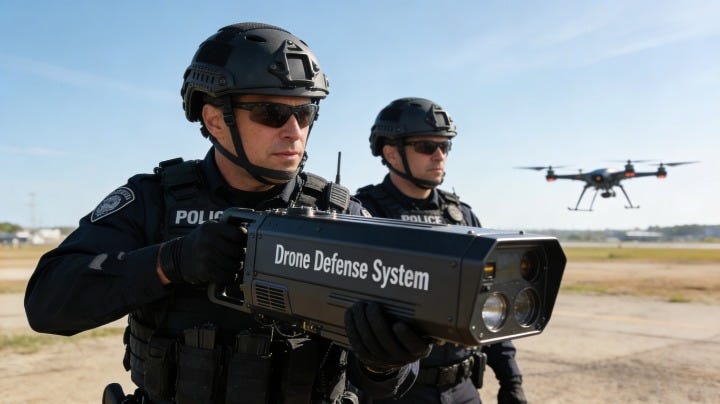
The rapid proliferation of unmanned aerial systems (UAS) has fundamentally changed the global security landscape. Counter-UAS (C-UAS) is no longer a niche capability or a one-time investment—it has become a continuously evolving requirement.
The core reason is simple: the drone threat is multi-dimensional, and the response must be equally multi-dimensional.
1. Strategic Urgency
The global number of drones—both military and civilian—has grown at an unprecedented pace. Alongside legitimate use, unauthorized, unidentified, and malicious drone activity is increasing just as rapidly.
In the military domain, drones have emerged as a defining element of modern conflict. Their low cost, high adaptability, and increasing autonomy enable asymmetric tactics that were previously impossible. Defense analysts project global military drone spending to grow from approximately USD 14.9 billion in 2025 to USD 28.6 billion by 2034, with a CAGR of around 7.5%, reflecting their central role in future force structures.
In the civilian domain, growth is even more explosive. Taking China as one reference point, registered drones reached 2.18 million by 2025, representing nearly 100% year-on-year growth. Similar trajectories can be observed across Europe and Asia-Pacific as drones become increasingly embedded in logistics, inspection, mapping, and urban air mobility.
This expansion dramatically increases risk exposure:
Unauthorized surveillance
Airspace disruption, particularly around airports
Potential delivery of hazardous payloads
Threats to critical infrastructure such as energy facilities, ports, data centers, prisons, and government buildings
In such an environment, C-UAS becomes a foundational layer of national and civil security, rather than an optional add-on.
2. Asymmetric Threat Economics: When Cost Ratios Collapse
One of the most underappreciated drivers of C-UAS demand is economic asymmetry.
Traditional air defense systems were designed to counter manned aircraft or high-value missiles. Applying those same systems against small commercial drones creates a severe imbalance. In some scenarios, the cost ratio of interceptor to target can exceed 600:1, making kinetic interception economically unsustainable.
At the same time, low-cost small UAS (sUAS) are increasingly capable of disabling or damaging high-value strategic assets. This asymmetry forces a shift away from single-layer, missile-centric defense toward specialized, cost-effective C-UAS architectures that combine detection, identification, tracking, and proportional response.
This economic reality is a key reason why AI-enabled sensing, electronic countermeasures, and integrated C-UAS systems are experiencing rapid growth.
3. Technology Lag Risk: C-UAS Is Always Playing Catch-Up
Drone technology evolves faster than most security systems.
While UAS manufacturers iterate quickly, many countermeasures lag behind due to longer investment cycles, regulatory approval processes, and operational deployment constraints. No single technology can provide comprehensive protection.
Meanwhile, drones are rapidly adopting capabilities specifically designed to defeat traditional countermeasures:
AI-enabled autonomous navigation
Fiber-optic control (OFC) that bypasses RF jamming, as observed in recent battlefields
Frequency hopping (FH) and advanced encryption
Swarming and cooperative behaviors
These developments directly undermine single-method “soft-kill” approaches. As a result, C-UAS must be multi-sensor, multi-effector, and continuously upgraded—not static deployments.
4. Demand Acceleration Across Military and Civil Sectors
Geopolitical instability and the expansion of civil drone operations are driving demand simultaneously from defense and non-defense users.
The fastest-growing application areas include:
Airport security, driven by rising incidents of unauthorized drone sightings and operational disruptions
Defense modernization, where C-UAS is increasingly treated as a standard capability rather than a niche one
Critical infrastructure protection, including nuclear power plants, energy grids, transport hubs, and government facilities
Market analysts forecast global C-UAS growth at a CAGR of approximately 26.5% (2025–2030), with Europe expected to grow at around 22.6% CAGR between 2026 and 2034*. Europe, alongside Asia-Pacific, is widely viewed as a key growth engine due to regulatory complexity, dense infrastructure, and cross-border security considerations.
*Referring to: MarketsandMarkets’ and Market Data Forecast’s anti-drone market reports.
5. Technical Complexity: Detection Is the Hardest Problem
From an engineering perspective, drones are inherently difficult targets:
Very small radar cross-sections (RCS)
Flight profiles similar to birds
Low operating altitudes and variable speeds
Increasing autonomy, reducing dependence on external command links
This makes reliable detection and classification the primary bottleneck of effective C-UAS. It also reinforces the need for sensor fusion—combining radar, RF, EO/IR, acoustic sensors, and AI-driven data correlation—rather than reliance on any single modality.
6. Regulation as a Demand Driver, Not a Barrier
Regulation is often perceived as a constraint, but in Europe it is increasingly a demand catalyst.
Frameworks such as EU U-Space aim to integrate drones safely into shared airspace. This integration inherently requires monitoring, identification, and enforcement mechanisms, many of which depend directly on C-UAS capabilities.
As regulatory clarity improves, authorized drone operations and counter-drone systems must evolve in parallel, driving structured, long-term demand rather than ad-hoc deployments.
Final Thought
Across both military and civilian domains, there is growing consensus that fundamental changes are required in:
Cost efficiency
Technology integration
Legal authorization
Training and operational concepts
C-UAS is not a product category—it is a continuously adapting security discipline. In a world where drones are everywhere, defending against them must be multi-dimensional, collaborative, and never static.
Curious to hear how others—especially system integrators and security professionals—see C-UAS evolving in their regions.
If you're interested a C-UAS you might be interested in : https://securiosity.substack.com/p/the-sky-wont-stay-empty-forever?r=1yq22x
Or : https://securiosity.substack.com/p/why-we-still-cant-tell-the-difference?r=1yq22x